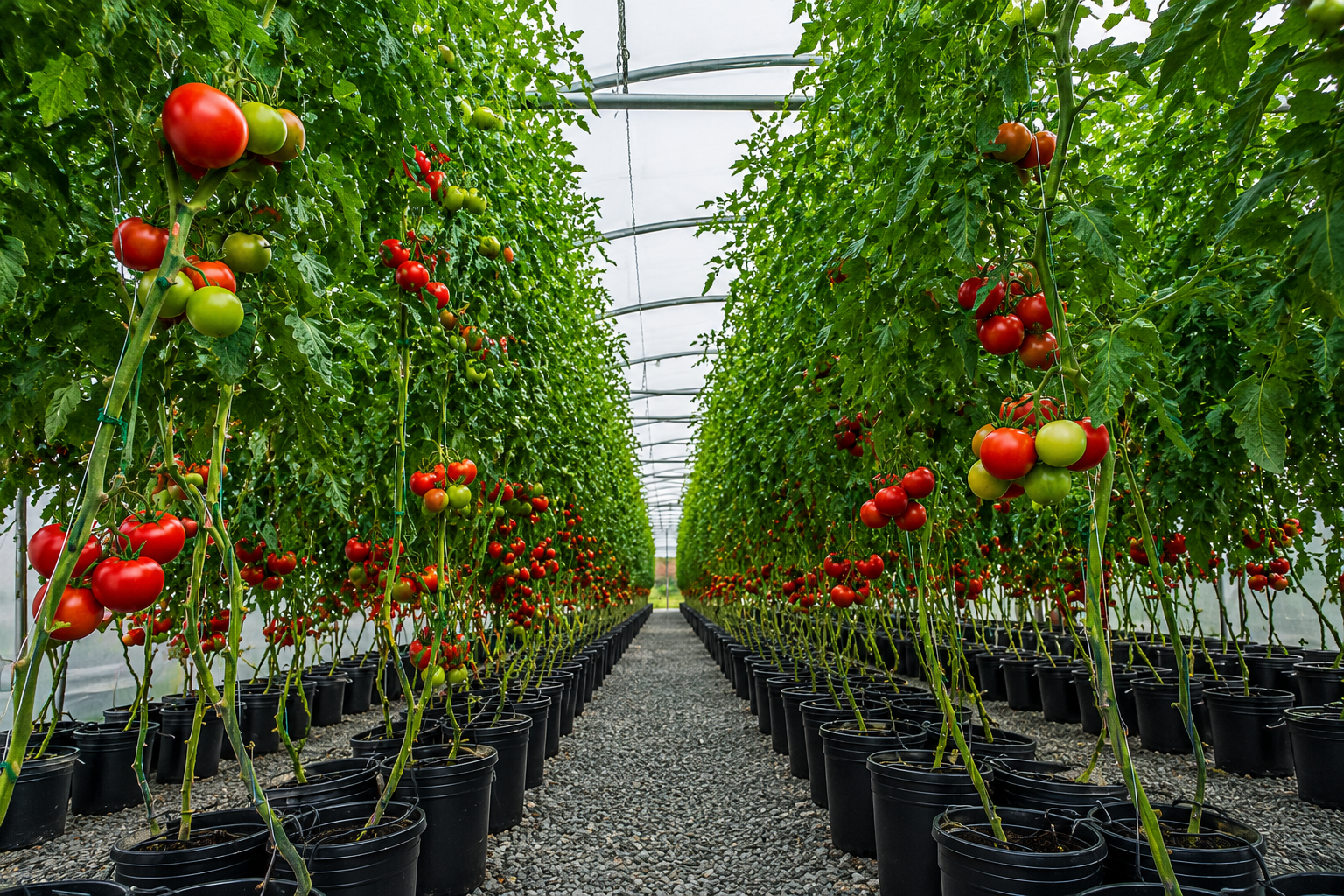
Loading plate I — 1,235,685 splats
Earth Models v0.1 · MILAN, IT
—:—:— UTC
ED. 2026.06 VOL. I · ISSUE 01 EARTH MODELS / WHITE PAPER

A spatial intelligence layer for agriculture

Earth Models for living systems

We are building 3D digital twins of greenhouses — reconstructing every plant from weekly camera passes, then turning that continuously updated state into harvest forecasts, early sickness signals, and the kind of resource decisions a grower used to make on intuition alone.

SCROLL
§ 00 ABSTRACT

Greenhouse growers commit to retailers and labour crews weeks before fruit ripens. Today they bridge the gap with manual sampling and gut feel. We argue that a spatial census of every plant, captured weekly and reconstructed in 3D1, becomes the substrate for a different operation — one where modern computer-vision and predictive models read the canopy directly, alongside the IoT sensors growers already deploy, to drive forecasts, flag stress before it spreads, and tighten resource use. Yield forecasting is the wedge; a closed-loop intelligence layer for growing systems is what we are building toward.

Loading plate II — 346,327 splats
PL · II · TARAXACUM OFFICINALE
AUTHORS
S. Scolari et al.
FILED
2026 · Q2
STATUS
Validation, Italian greenhouses
SUBJECTS
Tomato (primary) · Strawberry (validator)
§ 01 VISION

A measurement layer, then a control loop.

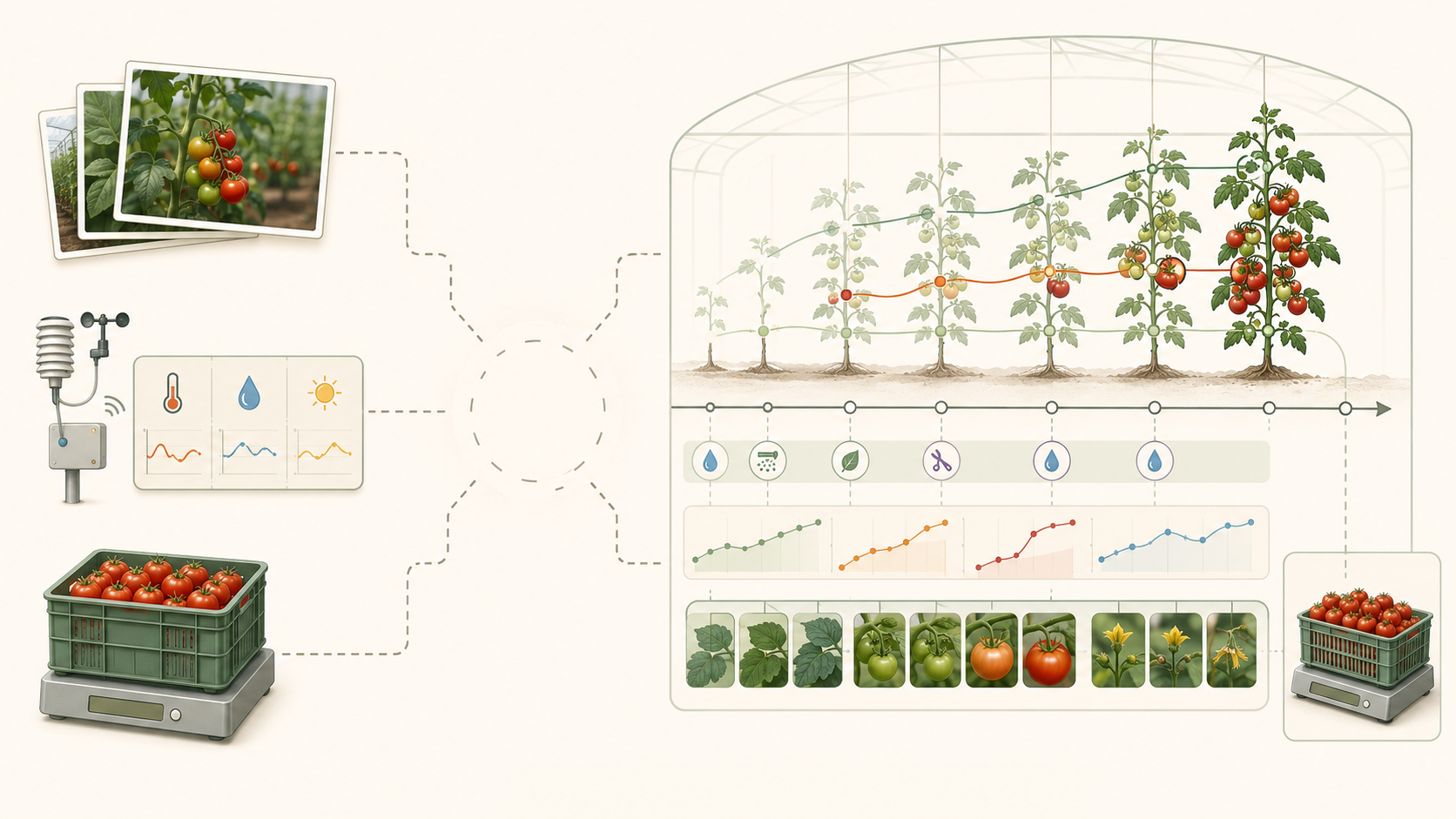
The 3D reconstruction is the substrate, not the product. Once the canopy is captured weekly as geometry, the same data feeds a stack of models — modern detection, segmentation, and forecasting networks have all leapt forward in the last three years — that turn a passive record into active control. Combined with the IoT sensors growers already run for climate and irrigation, the result is a holistic view of the operation: forecasts a grower can underwrite contracts on, stress signals surfaced before they spread, and resource decisions tied to plant-level evidence rather than block averages.

01MEASURE

Census, not sample

Every plant in the rows we walk, every fruit in the canopy, lifted into a georeferenced 3D scene. The unit of analysis becomes the individual fruit, not a per-block average.

02WEIGH

Kilograms from geometry

True 3D volume + a per-cultivar size-to-mass model gives weight directly. Where 2D systems undercount occluded fruit and double-count moving fruit, geometry fixes both — and weight is the metric retailers and crews price against.

03FORECAST

Calibrated kg per week, per zone

Pair the per-fruit census with greenhouse climate to project the ripening pipeline 1–3 weeks out. Zone-level disaggregation, with uncertainty bands, calibrated to the operator's actual harvest logs.

§ 02METHOD

Counting in three dimensions, not two.

Existing yield systems count in 2D and pay for it twice — fruit hidden behind leaves goes uncounted, and the same fruit gets re-counted across frames as the camera moves. Our edge is to reconstruct the canopy in 3D, so we see around occlusions, never double-count, and recover the metric that operators actually trade on: kilograms, not counts.

  1. M.01

    3D reconstruction of the canopy

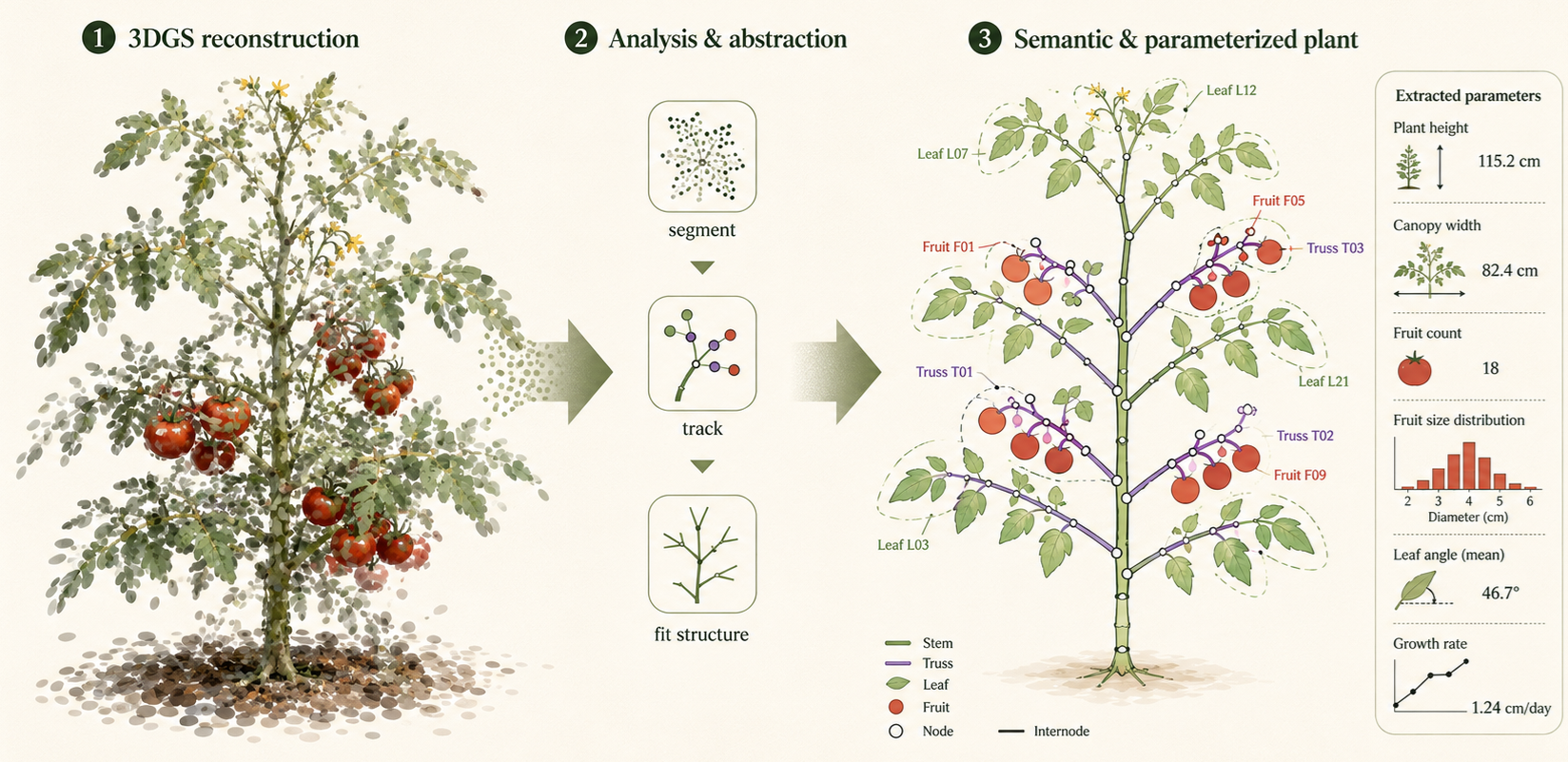
    A handheld or rail-mounted camera (an Insta360 works) sweeps each row weekly. We pair an off-the-shelf detector (YOLO + SAM) with structure-from-motion and 3D Gaussian Splatting1 to lift every row into a geometrically faithful, georeferenced 3D scene — each fruit a tracked instance with a position, a size, and a persistent identity across captures.

    • Multi-view: see fruit hidden behind leaves and other fruit
    • 3D identity: no double-counting across frames
    • True volume from geometry → weight via a per-cultivar size→mass model
  2. M.02

    Maturity staging from the canopy itself

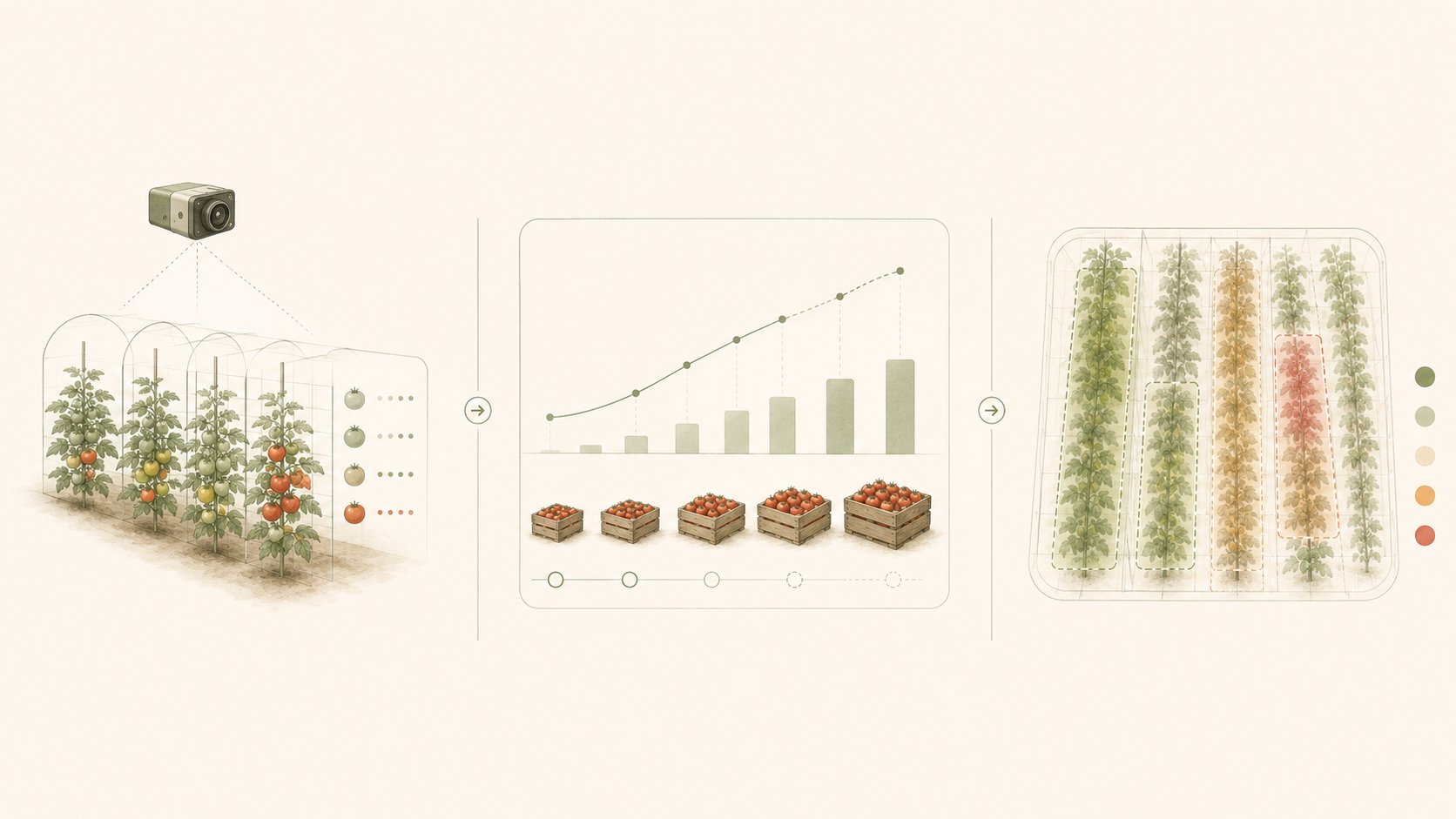
    Each tracked fruit is staged green → breaker → ripe from its 3D appearance. Knowing where each fruit sits in the ripening pipeline — not just how many there are — is what lets us forecast a harvest curve rather than a single number. Robustness across glazing, supplemental LEDs, and Mediterranean tunnel light is the open frontier we're investing in.

    • Per-fruit ripeness stage, not a per-row average
    • Census of every plant, not a sample of ten
    • Stable across glasshouses (Northern) and plastic tunnels (Southern)
  3. M.03

    Thermal-time forecasting

    Tomato and pepper ripening is dominantly temperature-driven2. We pair the per-fruit pipeline from M.01–M.02 with greenhouse climate data (temperature, daily light integral) to project when each cohort ripens and what it will weigh — kilograms harvestable per zone, per week, with uncertainty bands. Calibration is per-house and improves with every harvest cycle.

    • 1–3 week horizon — the length of the ripening pipeline
    • Disaggregated by zone for labour and logistics planning
    • Continuously recalibrated against the operator's actual harvest logs

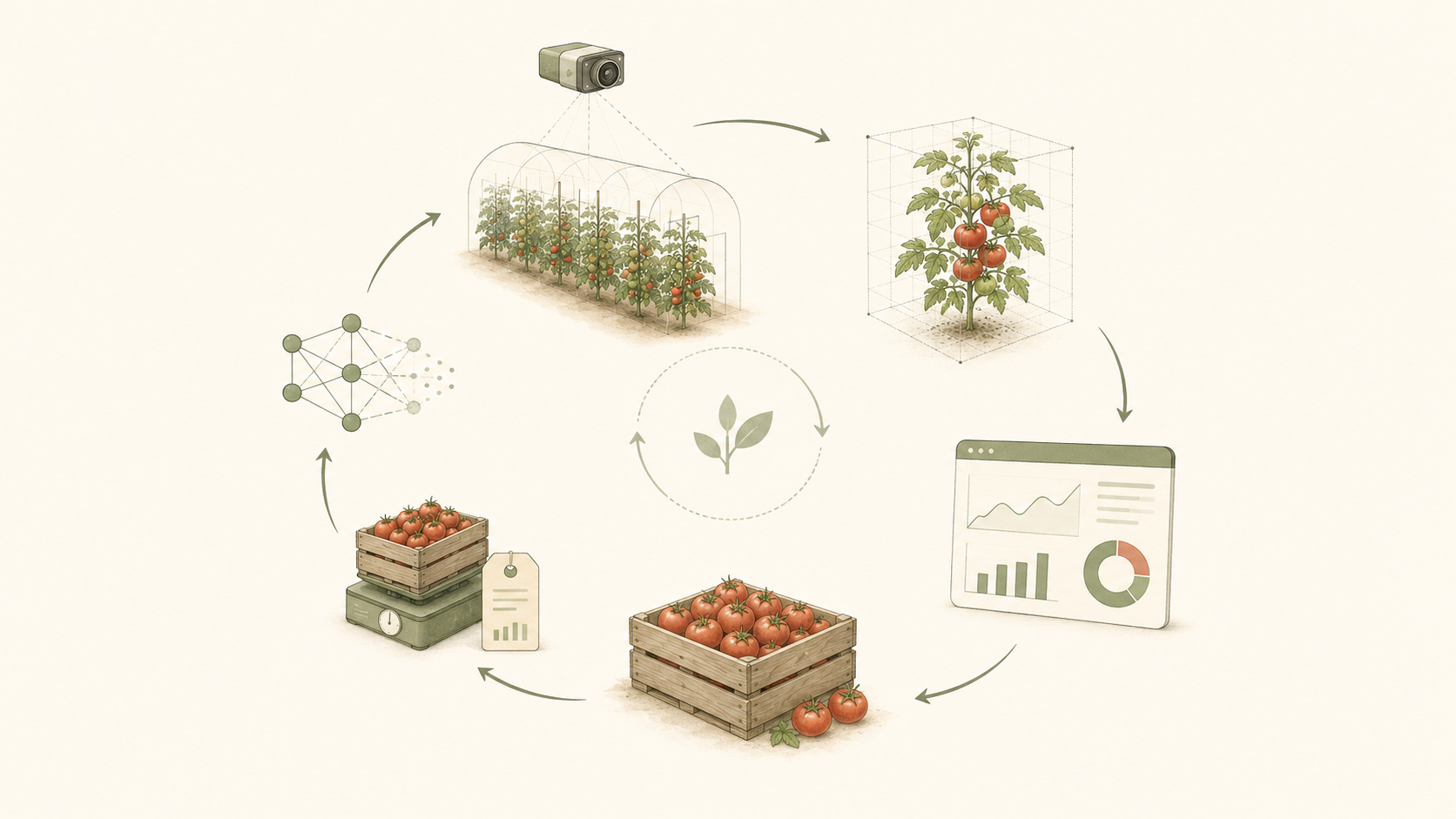
The 3D capture is what makes everything downstream tractable. A weekly geometric record of the operation is a state representation in the modern ML sense — the kind of input the last few years of computer-vision and forecasting research have learned to consume directly. Sized cohorts and ripening stages drive harvest forecasts. Geometry-and-colour anomalies feed stress and disease detectors, often days before symptoms are visible to a scout. Plant-level response to a fertigation change becomes attributable instead of averaged out. Pair that with the operator's existing climate and soil sensors and you have a closed loop: measure → predict → act → re-measure. The faster the loop runs, the closer the operation moves to actively rebalancing itself in response to what the canopy is telling it.

TABLE 01 · Method comparison vs. status quo
Manual samplingEarth Models
Coverage~ 10 plants / blockCensus of every plant
Volume estimation± 25 % typical error± 5 % from 3D geometry
CadenceWeekly, sparseWeekly, exhaustive
Forecast horizonGut-feel1 – 3 weeks calibrated
§ 03YIELD INTELLIGENCE

FIRST PRODUCT

A forecast precise enough to commit on.

A grower commits twice before any fruit is in hand: to a marketer for retail volume, and to a labour contractor for the picking crew. Both are paid for in days, not weeks. Under-deliver and you eat penalties or lose the listing; over-produce and you dump ripe fruit at fire-sale prices. We replace gut-feel with measured geometry — the same number drives both commitments.

B.01

Hold the listing

Retail supply contracts run on volume and consistency. A credible weekly forecast earns better terms — and avoids the fill-rate penalties and lost listings that follow a miss.

B.02

Match crew to load

Pickers are booked days ahead. Knowing the ripening load by zone means no idle crews on slow days and no over-ripe fruit on heavy ones.

B.03

Stop dumping fruit

A ripe tomato has days, not weeks. Forecast accuracy is the difference between selling at a contracted price and dumping the surplus into the wholesale market.

B.04

One number, every downstream step

The same forecast sizes packing-line shifts, graders, cold-chain, and transport. Get the forecast right and the whole post-harvest chain stops absorbing slack.

§ 04SUBJECTS

Crops with the shortest learning loops.

A startup learns at the rate of its predict → harvest → compare cycle. Crops with one harvest a year — apples, grapes, wheat — give a single validation event per season; we'd fail once and die. We pick continuously-harvested crops in controlled environments, where calibration is weekly.

SUBJECT · 01 · BERRY Fastest validator

Fragaria × ananassa

Tabletop day-neutral strawberry

Flower-to-ripe in 3–4 weeks, picked every 2–3 days, day-neutral varieties fruit continuously. Tabletop systems hang fruit below the canopy, so occlusion is minimal — the cleanest substrate to converge the perception model fast. We can validate a one-week forecast every week.

Cycle
3–4 wk
Forecast horizon
Days – 2 wk
Form
Tabletop / tunnel
SUBJECT · 02 · SOLANACEAE Primary market

Solanum lycopersicum

Indeterminate greenhouse tomato

An 8–11 month cycle harvested weekly yields 30–40 prediction-vs-actual events from a single crop, with hundreds of fruit per plant. It is the dominant Mediterranean greenhouse crop, the substrate the existing players validate on, and the natural commercial home for the product.

Cycle
8–11 mo
Forecast horizon
1–3 wk
Form
Indeterminate / glass
§ 05OUTLOOK

A real-time view, an actively-rebalancing farm.

A continuously updated 3D record of every plant is the input modern ML systems are best suited to consume. The directions below all share the same shape: feed the canopy state into a learned model, get back a decision a human used to make on intuition. The shorter the capture-to-action loop, the more the operation moves from being managed to being self-correcting.

F.01

Growth trajectories

Each tracked fruit becomes a time series — size, shape, ripening rate per cultivar and per zone. Phenotype data dense enough to inform variety selection and crop steering.

F.02

Stress, before symptoms

Anomalies in geometry, colour, and growth rate often precede the visible disease signal by days. With a weekly baseline of "normal" per zone, the deviations become detectable.

F.03

Inputs tied to outputs

Irrigation, fertigation, and climate setpoints are decided today against per-block averages. Plant-resolution measurement makes it possible to tie input changes to actual fruit-load response.

F.04

Quality, not just quantity

Premium-grade volume is what moves price. Per-fruit geometry plus illumination-corrected appearance is the route to forecasting it — once the underlying staging model is robust enough.

3D capture is the input. Modern ML on that state is the engine. Less waste, better decisions, faster response is the output. Yield forecasting is just the first place we ship it.

§ 06CONTACT

Looking for design partners in Italy.

If you run a tomato or strawberry operation under glass or tunnel and want a forecast credible enough to commit retail volume on, we're looking for a few partner sites for the 2026 season. Concierge capture, your harvest logs as ground truth, transparent reporting.

contact@earthmodels.ag
§ ◇REFERENCES
  1. [1] Kerbl, Kopanas, Leimkühler, Drettakis. 3D Gaussian Splatting for Real-Time Radiance Field Rendering. ACM TOG, 2023.
  2. [2] McMaster & Wilhelm. Growing degree-days: one equation, two interpretations. Agric. For. Meteorol., 1997.
  3. [3] Min, Ye, Xiong, Chen. Computer Vision Meets Generative Models in Agriculture: Technological Advances, Challenges and Opportunities. Appl. Sci. 15(14): 7663, 2025. doi:10.3390/app15147663
  4. [4] Ojo, La, Morton, Stavness. Splanting: 3D Plant Capture with Gaussian Splatting. SIGGRAPH Asia 2024 Technical Communications. doi:10.1145/3681758.3698009
  5. [5] Tabaa & Di Caro. GreenhouseSplat: A Dataset of Photorealistic Greenhouse Simulations for Mobile Robotics. arXiv:2510.01848, 2025. arxiv.org/abs/2510.01848
  6. [6] Jocher, Chaurasia, Qiu. YOLOv8 by Ultralytics. Open-source release, 2023. github.com/ultralytics/ultralytics